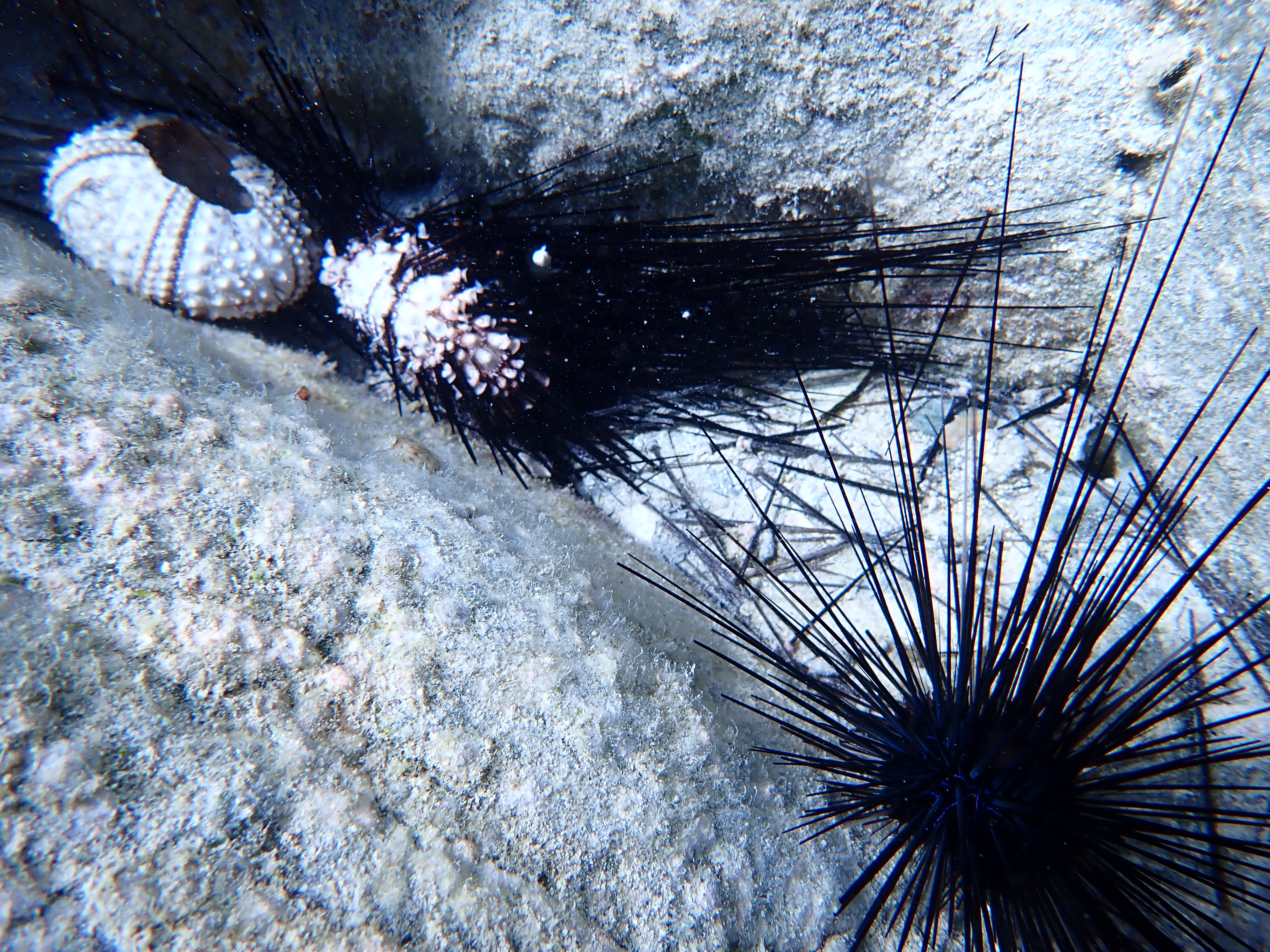
The long-spined urchin Diadema antillarum experienced mass mortality across the Caribbean in spring and summer 2022, wiping out large number of urchins at affected sites. A previous event affecting this species in 1983-1984, which killed >95% of Diadema across the region contributed to coral reef degradation, since these animals regulate the balance of corals and algae. The Caribbean die-off, which was named Diadema antillarum scuticociliatosis (DaSc), was caused by a scuticociliate most closely related to Philaster apodigitiformis (i.e. DaScPc) and causes animals to initially exhibit unusual behavior (e.g. ranging onto sand flats away from their normal habitat under rock outcrops), lose their tube feet and walk around on spines, then they lose their spines. Once spines drop the animals are quickly eaten by fish and other animals. Populations affected by DaSc are catastrophically affected – many/most individuals at a site may show disease signs and die rapidly.

Since the Caribbean outbreak, affected urchins in the Diadematidae have been reported in the eastern Mediterranean, Red Sea, and the Arabian Gulf. Very recently there have been anecdotal reports of mass mortality in the Seycelles and Reunion Island in the Indian Ocean. DaScPc has been confirmed in affected urchins from the Arabian Gulf and at other distant sites. The condition has so far been observed in two Diadema species (antillarum and setosum), as well as Echinothrix calamaria. At affected sites, only urchins in the Diadematidae are affected and not other co-occurring urchins.
Unfortunately, we are concerned that further mass mortality may affect Diadematidae elsewhere across the Indian Ocean, Southeast Asia, Australia, and beyond, and may result in degradation of coral reefs elsewhere. Affected genera of Diadematidae may include: Diadema spp. Astropyga spp., Centrostephanus spp., and Echinothrix spp. Urchins of these genera occur in tropical to subtropical waters worldwide.
On behalf of a team comprising Mya Breitbart (University of South Florida), Chris Kellogg (US Geological Survey St Petersburg), and working closely with Omri Bronstein (Tel Aviv University), along with others in affected regions, we would like to support investigation into mass mortality of long-spined urchins at sites where you may observe the condition!
Here are a few ways we can help:
- We can provide sampling materials to ensure long-term preservation of tissue samples and protocols to ensure that appropriate tissues are collected, so that you may perform additional work in the future at your institution or jurisdiction
- We can provide a protocol for light microscopic detection of scuticociliates, but please note that many different ciliates look the same by microscopy and may need to be confirmed by DNA sequencing.
- We can send PCR primers and protocols for the detection of DaSc at your institution or within your jurisdiction if you have access to molecular biology facilities (thermal cycler, electrophoresis, sanger sequencing, etc).
- We can provide support for molecular detection of the DaScPc at team institutions at no cost to you, including arranging transport of materials to our places of work. Materials remain your property and the property of your jurisdiction and would be used solely for the purpose of detecting DaScPc and extracted nucleic acids returned to your lab or destroyed upon request.
- We would be pleased to collaborate on research more widely on this topic (including collaborative publication), but please know that it is our preference to support efforts at your institution and jurisdiction.
Please let us know if we can help by contacting either Ian Hewson (hewson@cornell.edu), Mya Breitbart and/or Omri Bronstein.
We still do not understand how the parasite is spread, but can advise on a few best practices which apply to marine microorganisms in general. These include:
- Avoid moving affected or normal urchins from one location to another
- Wash all SCUBA diving/snorkeling gear, including the air bladders of buoyancy compensating devices with freshwater and dry equipment between sites.
- For aquariums and other containment facilities which rely on inflow/outflow systems: consider installing a filter on both in/outflow which retains particles >1um. For example, a sand filter with sufficiently developed organic matrix, or a mesh filter to retain particles
- For vessels, consider replenishing firefighting wells or ballast far from shore
Work is underway for treating affected urchins, which will be especially of interest to aquaculture facilities and aquariums. However, we do not yet have any advice.
 Cornell Marine Mass Mortality Laboratory